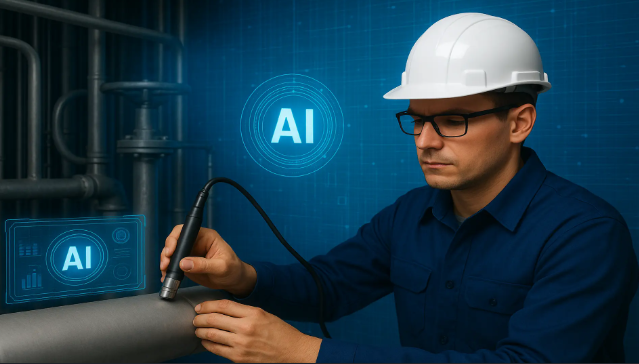
Artificial intelligence reshapes industrial inspections by integrating automated data capture, analysis, and decision-making across complex value chains. It emphasizes governance, safety, and ethics while monitoring model drift and preserving human-in-the-loop interpretability. Edge computing enables scalable, autonomous operations, supported by robust data governance and bias testing. A modular hardware-software approach and reproducible pipelines foster rapid experimentation; yet, aligning algorithmic performance with real-world outcomes remains a critical, ongoing challenge to address.
How AI Transforms Industrial Inspections
Artificial intelligence redefines industrial inspections by automating data collection, analysis, and decision-making across complex value chains.
The analysis emphasizes AI ethics, bias testing, safety regulations, and data governance, ensuring model drift is monitored and mitigated.
A human in the loop sustains interpretability considerations, deployment scalability, edge computing, cyber resilience, and robust governance for reliable, autonomous yet controllable inspection ecosystems.
See also: heelnews
Choosing AI Tools for Your Inspection Classifications
In assessing suitable AI tools for inspection classifications, organizations must align technology choices with the practical demands identified in automated data collection and governance from prior discussions.
Tool selection emphasizes suitability for precision audits and robust model training, balancing interpretability with performance.
An experimental mindset supports rigorous benchmarking, while governance constraints guide data labeling, versioning, and reproducibility for scalable, dependable inspection classifications.
Implementing AI: Data, Hardware, and Workflow Integration
Implementing AI in industrial inspections requires a disciplined alignment of data, hardware, and workflow to ensure reliable performance in real-world environments.
Effective data governance underpins model integrity, traceability, and compliance, while robust data labeling informs annotation quality and category consistency.
Hardware-software coherence, modular interfaces, and reproducible pipelines enable iterative experimentation, reducing drift and accelerating deployment without compromising safety or interpretability.
Measuring Impact: Quality, Safety, and ROI Metrics
Measurement of impact in industrial inspections requires a disciplined assessment framework that links algorithmic performance to tangible outcomes. The analysis evaluates accuracy metrics against fault detection and false alarm rates, calibrating thresholds for real-world tasks. Safety improvements and ROI are quantified through incident reduction and downtime costs. Maintenance implications emphasize model drift, periodic retraining, and component lifecycle considerations to sustain reliability and operational clarity.
Frequently Asked Questions
How to Handle AI Model Drift in Inspections Over Time?
Model drift and data drift are mitigated by continuous monitoring, regular revalidation, and incremental retraining with labeled, representative data; a principled experimentation framework exposes performance gaps, enabling timely model updates while preserving safety and compliance in inspections.
What Are Ethical Considerations for Automated Inspection Decisions?
Automated inspection decisions raise privacy concerns and require bias mitigation; the analysis emphasizes transparent data provenance, auditable reasoning, and stakeholder-inclusive governance. An experimental mindset favors ongoing evaluation, documenting uncertainties, and balancing efficiency with accountability and user autonomy.
How to Protect Proprietary Inspection Data From Breaches?
Data encryption and access control fortify proprietary inspection data against breaches; the approach, though precise, remains experimental. The analyst alludes to secure channels and layered permissions, enabling freedom-focused enterprises to evaluate risk while preserving competitive advantage.
Can AI Scale Across Multi-Site, Heterogeneous Equipment?
The answer: AI can scale across multi-site, heterogeneous equipment only if standardized data interfaces and robust federation address scalability challenges within heterogeneous ecosystems, balancing interoperability, governance, and local edge computing to preserve performance while enabling experimental, freedom-friendly adoption.
What Training Resources Best Accelerate Operator Adoption?
Insightful how-to: AI training accelerates operator adoption through hands-on modules, real-world simulations, and bite-sized curricula. It emphasizes data privacy and security measures, while measuring comprehension with metrics. The approach fuses rigorous analysis with an experimental, freedom-seeking mindset.
Conclusion
Artificial intelligence in industrial inspections crystallizes into a precision-driven oracle, forecasting faults with the certainty of sunrise and trimming downtime with surgical exactness. Its data governance becomes a fortissimo governance choir, harmonizing drift, bias, and compliance into an unstoppable feedback loop. Yet, the true innovation lies in the experimental mindset: rapid prototyping, edge-optimized pipelines, and human-in-the-loop interpretation that keeps operators ahead. When measured against real-world outcomes, AI delivers ROI, safety gains, and lifecycle resilience beyond conventional expectations.
